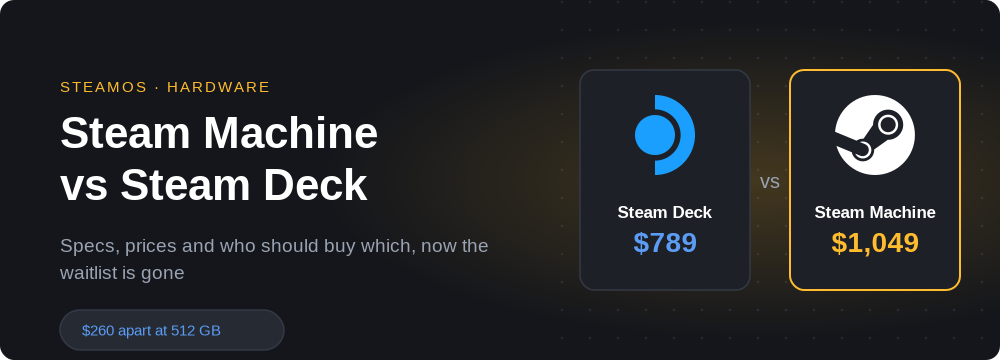
On 19 November Valve stopped taking Steam Machine waitlist signups. The 512 GB model can now be bought outright while stock lasts, and Valve has warned that prices may rise again because memory and storage keep getting more expensive. Meanwhile the Steam Deck costs far more than it did a year ago.
Both run SteamOS, both play the same Steam library, and they’re now only $260 apart. So which one should you buy? This post compares them on price, performance, memory, ports, upgrades and software, and ends with a short “who should buy which”.
TL;DR
- Price: Steam Machine $1,049 (512 GB) / $1,349 (2 TB). Steam Deck OLED $789 (512 GB) / $949 (1 TB).
- Performance: the Steam Machine has a 6-core Zen 4 CPU and a 28-CU RDNA 3 GPU with 8 GB GDDR6. That’s about 5.5x the Deck’s GPU on paper. Valve’s own target is now “up to 4K with FSR 4.1”, not native 4K60.
- The Deck is a whole system: screen, controls and battery are included. The Steam Machine needs a TV or monitor and a controller, sold separately.
- The Steam Machine is the better living-room PC: Ethernet, HDMI with CEC, DisplayPort, five USB ports, upgradeable RAM and a spare M.2 2280 slot.
- Buy the Deck if you’ll play away from the TV. Buy the Steam Machine if you play on a TV and want 1440p/4K-ish settings. If you already have a gaming PC, you probably need neither.
Prices in November 2026
| Steam Deck OLED | Steam Machine | |
|---|---|---|
| Base model | $789 (512 GB) | $1,049 (512 GB) |
| Top model | $949 (1 TB) | $1,349 (2 TB) |
| Included | screen, controls, battery, case | box only |
| Still need | nothing (a dock for TV use) | controller, TV or monitor |
| Availability | in stock | 512 GB while supplies last; 2 TB limited |
Both prices are the result of the RAM shortage:
- Steam Deck: on 27 May 2026 Valve raised the OLED from $549 to $789 and from $649 to $949. Valve said the Deck “itself hasn’t changed”. The cheaper LCD model was discontinued in December 2025. That makes the OLED the only Deck you can buy new, and the entry price has nearly doubled since the $399 launch model in 2022.
- Steam Machine: it was announced in November 2025 without a price, delayed in February 2026 because of RAM costs, and launched on 22 June 2026 at $1,049 and $1,349. Valve said its original price goal was “no longer viable”. The controller isn’t included; bundles cost more.
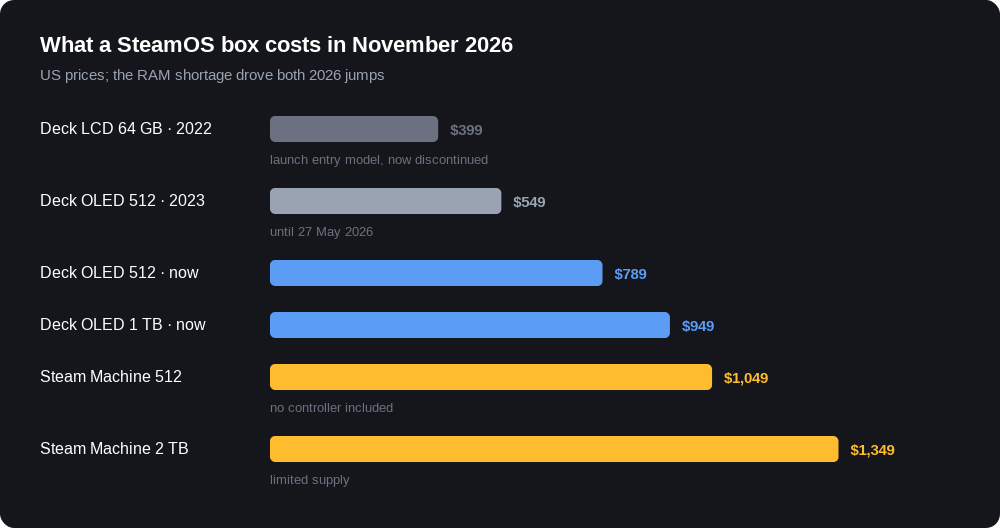
Valve hasn’t said when the next price rise will come or how big it will be. If you’re going to buy either one, sooner is unlikely to be more expensive than later.
Specs side by side
| Steam Deck OLED | Steam Machine | |
|---|---|---|
| CPU | 4-core / 8-thread Zen 2, 2.4–3.5 GHz | 6-core / 12-thread Zen 4, up to 4.8 GHz |
| GPU | RDNA 2, 8 CUs, up to 1.6 GHz | RDNA 3, 28 CUs, up to 2.45 GHz |
| GPU compute (FP32) | 1.6 TFLOPS | ~8.8 TFLOPS (28 CU × 64 × 2 × 2.45 GHz) |
| Memory | 16 GB LPDDR5, shared, soldered | 16 GB DDR5 (1 SO-DIMM) + 8 GB GDDR6 VRAM |
| Power | 3–15 W APU, 50 Wh battery | 30 W CPU + 110 W GPU, internal PSU |
| Storage | M.2 2230 + microSD | M.2 2230 + spare M.2 2280 + microSD |
| Display out | 1x USB-C (DP 1.4) | DP 1.4 + HDMI 2.0 (CEC) |
| Network | Wi-Fi 6E, BT 5.3 | Wi-Fi 6E, BT 5.3, Gigabit Ethernet |
| Size / weight | 298 × 117 × 49 mm, 640 g | 156 × 152 × 162 mm, 2.6 kg |
The Steam Machine figures come from Valve’s launch specs as collected on Wikipedia. Valve doesn’t publish a TFLOPS number for the Steam Machine, so the 8.8 is my own calculation with the standard formula, without counting RDNA 3’s dual-issue.
What “6x a Steam Deck” means in games
Valve’s launch claim was that the Steam Machine is more than six times as powerful as the Deck, enough for 4K60 with FSR and ray tracing. Shortly before release Valve softened that to “up to 4K gaming with FSR 4.1”. IGN said the original claim needed a “significant amount of tweaking settings”.
The Verified programs give a better sense of what each box is aimed at:
- Steam Deck Verified targets the Deck’s own 1280×800 screen at playable frame rates.
- Steam Machine Verified targets 1080p at 30 fps. Every game that’s Steam Deck Verified counts as verified on the Steam Machine automatically.
In practice: games that the Deck runs at 800p with low settings and FSR, the Steam Machine runs at 1080p or 1440p with higher settings. Lighter games and older AAA titles can reach 4K with upscaling. The newest heavy games are 1080p–1440p with FSR on the Steam Machine, and often don’t run well on the Deck at all.
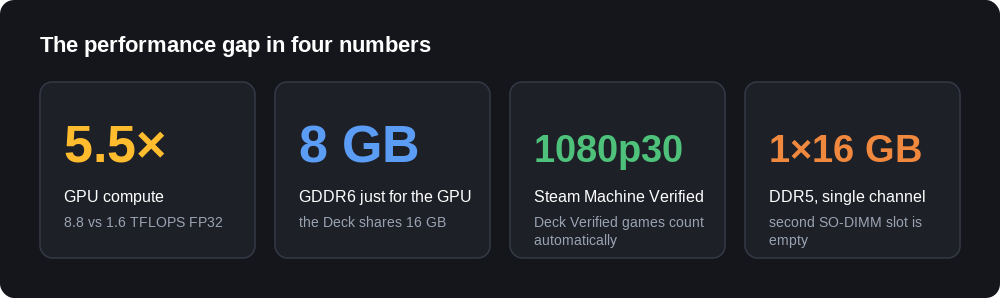
The difference is there, but it’s a console-class jump, not a high-end PC. Wikipedia compares the GPU to a laptop Radeon RX 7600M.
The memory catch
Two memory details are worth knowing before you pay $1,049:
- The Steam Machine ships with a single 16 GB DDR5 stick. Valve first said the RAM could be one or two modules, then confirmed only a 1×16 GB configuration. Digital Foundry reported it in launch week. Single-channel memory costs CPU performance in some games. There are two SO-DIMM slots, so you can add a second stick for dual channel, but with today’s DDR5 prices that’s not cheap. Match the speed and size of the stick that’s already in.
- The Deck’s 16 GB is shared between CPU and GPU and soldered to the board. You can’t upgrade it, but it was designed as a single unified pool from the start.
The Steam Machine’s 8 GB of GDDR6 belongs to the GPU alone. That’s what lets it run higher textures and resolutions than the Deck.
Ports, network and the living room
This is where the Steam Machine is clearly better, and it matters if the box lives under a TV:
- Wired network. Gigabit Ethernet for downloads, Steam Remote Play and game streaming. The Deck needs a dock for Ethernet.
- HDMI with CEC, so the TV remote and power-on can work together. It’s HDMI 2.0, not 2.1. Valve lists up to 4K at 120 Hz with HDR and FreeSync. For HDMI 2.1 features, use the DisplayPort 1.4 output with a monitor or an adapter.
- Five USB ports (two USB-A 3.2 on the front, one USB-C 3.2 Gen 2 and two USB-A 2.0 on the back) and a built-in 2.4 GHz receiver for the Steam Controller.
- A 120 mm fan in a small cube. A big, slow fan is usually quiet, though I haven’t found measured noise figures.
The Deck has a single USB-C port. On a TV it’s a 15 W handheld in a dock, driving an output resolution it was never designed to render at.
Storage and upgrades
- Steam Deck: one M.2 2230 SSD plus microSD. Swapping the SSD is a well-documented job, but 2230 drives cost more per terabyte than full-size ones.
- Steam Machine: the 2 TB model uses an M.2 2230 drive, and there’s a free M.2 2280 slot for any standard NVMe SSD, plus microSD on the front. That’s the cheapest way to get a large library: buy the 512 GB model and add your own 2 TB 2280 drive.
Software: same SteamOS, slightly different freedom
Both run SteamOS 3, which is based on Arch Linux. Game compatibility through Proton is the same on both, since anything that works on the Deck works on the Steam Machine. Both also have desktop mode: leave Game Mode for a full KDE Plasma desktop and install Flatpaks, a browser, Lutris or Heroic for non-Steam stores. On the Steam Machine, with a keyboard and mouse plugged in, that turns it into a small, capable Linux desktop PC.
- Windows: Valve released Windows drivers for the Steam Machine shortly after launch, so you can wipe SteamOS and install Windows (useful for games with anti-cheat that blocks Linux). Dual boot wasn’t supported as of July. The Deck has had Windows drivers for years.
- SteamOS on other PCs: SteamOS 3.8 added support for installing on non-Valve hardware. If you already own a reasonably modern gaming PC, you can get most of the Steam Machine experience for free.
Reliability and supply
Two things to know before buying the Steam Machine:
- Early hardware reports. In July Digital Foundry covered GPU failures that show up as a “red line of death” on the front LED bar. It’s not clear how widespread they are. Buy from Valve directly so returns are simple.
- Supply. Valve said the launch quantity was “less than we wanted to be able to make”. The 512 GB model is in stock until it runs out. For the 2 TB model, demand is still bigger than production, and Valve says it will build fewer than planned. If the 512 GB model is gone, Valve marks it out of stock; there’s no new waitlist.
The Deck is a mature product, in stock, with nearly five years of fixes behind it. Valve is working on a successor but only wants to ship one with “a very delineated performance improvement”, and it hasn’t given a price or date. I wouldn’t wait for it.
Who should buy which
The first question is where you’ll play. After that, it’s about what you already own.
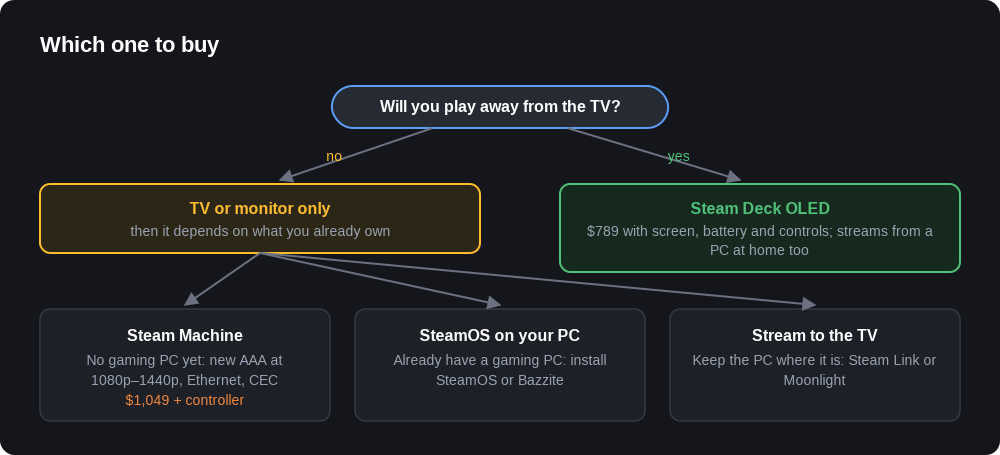
Buy the Steam Deck OLED if:
- you play in bed, on the sofa away from the TV, or while travelling
- you mostly play indies, older games or anything Deck Verified
- you don’t own a TV-ready controller and don’t want to buy one
- $789 is already the limit
Buy the Steam Machine if:
- you play on a TV or monitor almost all the time
- you want new AAA games at 1080p–1440p, or lighter ones at 4K with FSR
- you care about Ethernet, CEC and upgrading storage and RAM
- you’d like a quiet Linux box that also does Steam Remote Play to other devices in the house
Buy neither if you already have a gaming PC from the last few years. Install SteamOS or Bazzite on it, or stream it to the TV with Steam Link or Moonlight. You’ll get a similar living-room setup without paying 2026 RAM prices.
Own a Deck already? Keep it. A Steam Machine doesn’t replace it, and the Deck can stream from the Steam Machine (or any gaming PC) over your home network. Treat the Steam Machine as an addition for the TV, not an upgrade.