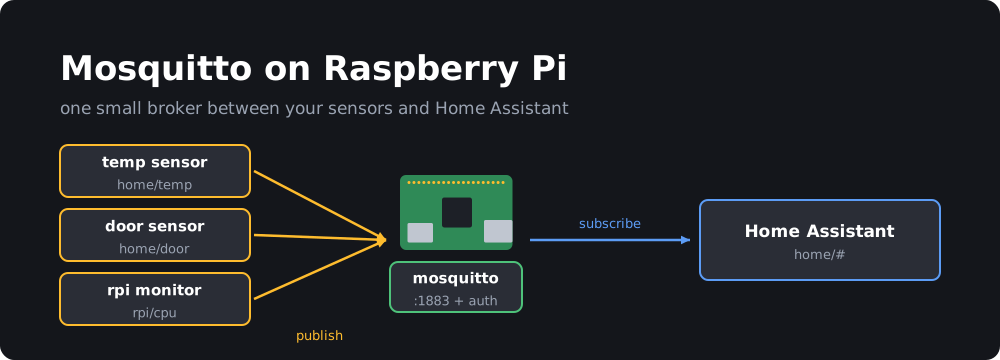
Mosquitto is a small, fast MQTT broker that runs happily on any Raspberry Pi. I use it as the message bus between my sensors and Home Assistant. These are the steps to install it and lock it down with a username and password.
1. Install Mosquitto
sudo apt update
sudo apt install -y mosquitto mosquitto-clients
sudo systemctl enable --now mosquitto
mosquitto-clients gives you mosquitto_pub and mosquitto_sub for testing.
2. Create a password file
You’ll be prompted to enter the password:
mosquitto_passwd -c passwordfile user
Use -c only for the first user. It creates a new file and overwrites an existing one.
3. Move the password file to /etc/mosquitto
sudo mv passwordfile /etc/mosquitto/
sudo chown mosquitto: /etc/mosquitto/passwordfile
sudo chmod 0700 /etc/mosquitto/passwordfile
Recent Mosquitto versions warn if the password file is readable by other users.
4. Configure the broker to use the password file
Create a custom config file in /etc/mosquitto/conf.d:
sudo nano /etc/mosquitto/conf.d/config.conf
The file name has to end in .conf, otherwise Mosquitto won’t load it.
Here is the configuration I am using, and it works fine with Home Assistant:
user mosquitto
max_queued_messages 200
listener 1883 0.0.0.0
allow_zero_length_clientid true
allow_duplicate_messages false
autosave_interval 900
autosave_on_changes false
persistence true
persistence_file mosquitto.db
allow_anonymous false
password_file /etc/mosquitto/passwordfile
The listener line matters: since Mosquitto 2.0 the broker only accepts connections from localhost unless you define a listener.
Restart the broker to load the config:
sudo systemctl restart mosquitto
5. Test it
In one terminal, subscribe to a test topic:
mosquitto_sub -h localhost -t test/topic -u user -P your-password
In a second terminal, publish a message:
mosquitto_pub -h localhost -t test/topic -m "hello" -u user -P your-password
If hello shows up in the first terminal, the broker works. Try the same command without -u and -P. It should be refused, which means anonymous access is off.
Logs
sudo cat /var/log/mosquitto/mosquitto.log
sudo journalctl -u mosquitto
To connect Home Assistant, add the MQTT integration and point it at the Pi’s IP address, port 1883, with the user and password you created.